Please register for the event on the Urban Coast Institute’s website Attendees will be provided a link to the webinar upon registering.
Please join us for a free expert panel discussion on how stormwater pollution and flooding affects the health of local water bodies. The event is being hosted by the Whale Pond Brook Watershed Association in partnership with Clean Ocean Action, the Long Branch Green Team, the Monmouth University Urban Coast Institute, and the New Jersey Chapter of the Sierra Club.
Sophie Glovier, municipal policy specialist for the Watershed Institute, will discuss steps residents can take to combat stormwater runoff pollution in their towns.
Dr. Jason Adolf, Monmouth University endowed associate professor in marine science, will share observations from current research on the linkages between rainfall and microbial pollution at surfing beaches near outflow pipes and storm drains in Asbury Park, Deal and Long Branch.
For more information or questions, contact Faith Teitelbaum at faithteitel@gmail.com.
Kansas City has become a national leader in stormwater management by combining green infrastructure and digital technology! Read about why we should push for Stormwater Utility near us!
We are excited to announce that WPBWA is now on instagram! Download the instagram app and search @whalepondwattershednj or go to www.instagram.com/whalepondwatershednj to check out what is happening!
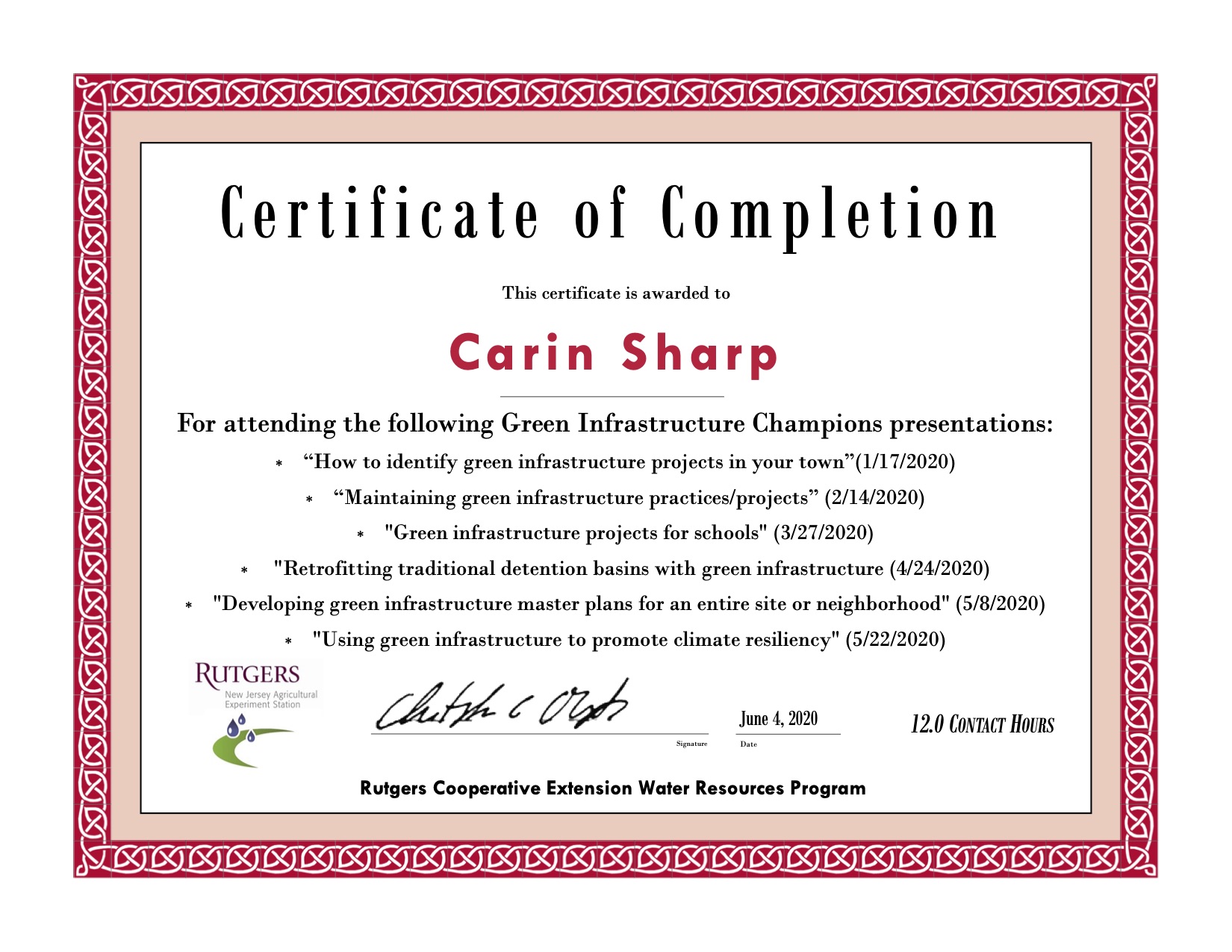
Our trustees, Scott and Carin Sharp and Faith Teitelbaum have completed the Champions of Green Infrastructure Course with Dr Chris Obropta, Rutgers Water Resources Division.
Saturday, May 2 and Sunday, May 3 are expected to be beautiful days. Now is the time to prepare the gardens for even more beautiful days in the future. Routine garden maintenance is a great way to get out of the house, enjoy the weather and lift your mood. So, head to Ross Lake with a sharp pair of bypass pruners and your favorite weeding tools. Come when you feel like it.
Even though there is no volunteer time schedule, a logical sequence of work is important to think about. The following tasks are listed by seasonal importance. In other words, these are the things that need to be done at this particular time of the year. They are listed in order of most important to least important.
Finish pruning the Red Twig Dogwood at the east and west entrances to the trail.The ones at the west end are in the most need of pruning. Start by removing some of the “runners” that grow horizontally along the ground. Then, remove all dead stems. These are easy to spot now. The stems are brown or grey, without buds or leaves. Nothing else on the dogwood should be pruned. They are getting ready to bloom!
Remove all leaves, grass and weeds underneath shrubs.Clear the area to about one foot past the outer branches, especially around those shrubs that are nearest to the street. Long Branch DPW mows the grass between the curb and the garden. Most maintenance crews like to have a “margin of error” so that the they don’t have to bring their mowers too close to the shrubs.
Remove any invasive vines or plants growing in the grasses between the path and the lake.They are easy to spot now, but they will be hidden soon.
4. Remove all plants growing in the path.
Butterflies lay their eggs on the dead flower stems in the pollinator garden. They also serve as markers for emerging plants we want to keep. Let’s leave them for now.
If you want to do some digging, some of the grasses need to be replanted at the end of Red Oaks Drive, across the lake. The soil around the roots may have eroded during the winter, exposing the root ball. They are beginning to grow, however, in spite of root exposure.
Please be considerate of any visitors by wearing a face covering.
The garden in late March shows the stems and seed pods of last summer’s perennials. Dried leaves helped to protect plant roots during winter, returned nutrients to the soil and provided a home for moths and insects.
Last summer, we planted grasses on the opposite bank of the lake, seen in the distance. These prevent erosion and are the are the beginnings of another garden requested by the neighbors.
After surveying the garden, we decided it was time to prune summersweet clethra now, before new growth appears. These plants bloom only on new shoots. Pruning stimulates new growth.
Spent hydrangea blooms need to be removed. Cut back to the first new bud on the stem.
March is the time to prune shrubby dogwoods such as blood twig and red-osier. Remove some or all of the brown stems. Young stems are bright red.
As we leave, we need to think about saving the brush removed from the butterfly garden, since butterflies lay their eggs on and inside the hollow stems. Caterpillars will emerge if we pile the brush together in a separate part of the garden.
Do you put a hose from your pool to the street to empty your pool?
Do you know that the water goes into the street and down the storm drain. Storm drains do NOT go to the sewer treatment plant. They lead to the nearest body of water, for instance Takanassee Lake.
So what can you do?
Swimming Pool Waste Water Fountains are designed to re-purpose properly balanced swimming pool waste water for irrigation. They can be used with sand or cartridge filtration systems. Their spray aerates waste water by sending it approximately six feet into the air. The returning water falls back to the ground like rain typically covering 100 square feet where it can be absorbed into the soil and water the grass.
And what about the grass? Chlorine levels are reduced through the process of aerating swimming pool water.
Waste Water Fountains also reduce the soil erosion normally caused by the forceful blast of a wastewater hose.
Construction is typically durable HDPE plastic. Some models are light enough to carry around with your fingertips. The ones made of HDPE are also recyclable.
You can also talk to someone from your Green Team and ask them to add an ordinance to your town Master Plan.
Here is a sample of a town ordinance in Monmouth County. Check your town’s stormwater ordinance and see what it says.
Per ordinance, it is unlawful to discard, spill or dump any material other than storm water into the municipal storm water system. Further, an illicit connection which is defined as any system that discharges domestic sewerage, swimming pool water, process wastewater or pollutants, is prohibited from discharging to the storm water system. Swimming pool water must be disposed of on the pool owner’s property. Waste water fountains are a good option to reduce water consumption, recycle pool water onsite and minimize soil erosion. The purpose of this ordinance is pollution and contamination prevention.
Swimming Pool Waste Water Fountains are designed to re-purpose properly balanced swimming pool waste water for irrigation. They can be used with sand or cartridge filtration systems. Their spray aerates waste water by sending it approximately six feet into the air. The returning water falls back to the ground like rain typically covering 100 square feet where it can be absorbed into the soil and water the grass.
And what about the grass? Chlorine levels are reduced through the process of aerating swimming pool water.
Waste Water Fountains also reduce the soil erosion normally caused by the forceful blast of a wastewater hose.
Construction is typically durable HDPE plastic. Some models are light enough to carry around with your fingertips. The ones made of HDPE are also recyclable.
Neighbors working together to restore our watershed.